How to Use XY Bass: Depth, Translation, and the Line Between Them
What the two axes of XY Bass actually move, how the pitch tracker decides between reinforcing a fundamental and rebuilding it, and which of the 13 presets to start from on a bass, a kick or a mix bus.
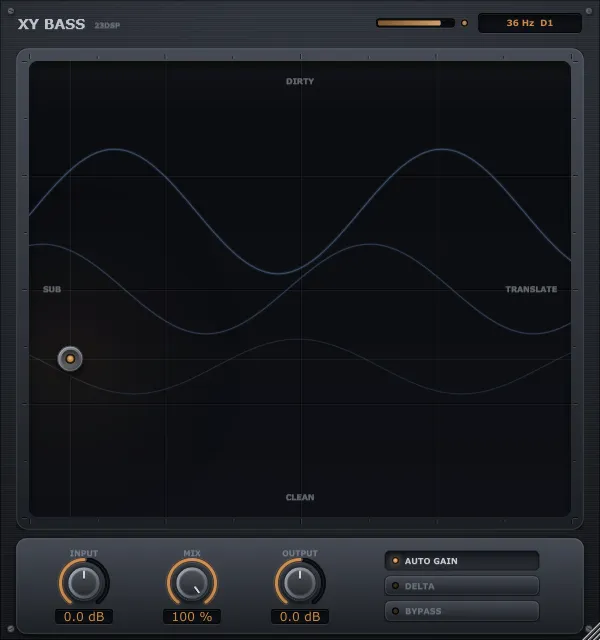
XY Bass has two axes and three knobs, and the two axes do almost all of it. This is what they move.
The horizontal axis: SUB to TRANSLATE
These are not two amounts of the same thing. They are two different answers to the same problem.
SUB is depth you feel. The plug-in puts energy at or near the fundamental of the note it is tracking. On a system that reproduces 40 Hz this is the thing that makes a room move.
TRANSLATE is depth you hear on a system that does not reproduce 40 Hz. It generates harmonics above the fundamental, and your ear reconstructs the missing root from them — the missing fundamental effect. A laptop speaker cannot move air at 40 Hz, but it can play 80, 120 and 160 Hz, and you will hear a 40 Hz note.
Most of the time you want some of both, which is what the middle of the pad is. Far left is a club record. Far right is a record that has to survive a phone. The honest answer for most mixes is around 0.3 to 0.5.
The vertical axis: CLEAN to DIRTY
How much character the plug-in is allowed to add on the way. At the bottom the generated content is as close to pure as it gets — at the CLEAN SUB corner, a 150 Hz tone at −3 dBFS comes out with its third harmonic 59 dB down. Going up adds saturation and grit, which also makes the harmonic translation stronger, because saturation is where extra harmonics come from.
A sustained 808 usually wants to stay low on this axis. A short, aggressive bass can take a lot of it.
What the tracker is doing
The readout above the pad is the note XY Bass has locked onto. It matters, because it decides which of two jobs the plug-in is doing:
- Reinforcement — the fundamental is already in the signal and gets strengthened.
- Reconstruction — the fundamental is missing or too weak, and an oscillator locked to the tracked pitch puts it back.
The difference is audible, and it is the one case where a sub generator can go badly wrong: a generator that follows the loudest partial rather than the actual pitch will track the second harmonic and put the sub an octave high. Watch the readout on a part with a lot of distortion on it, and give the tracker a moment on the first note — it needs a cycle or two to be sure.
The plug-in also reads how tonal or percussive the material is and how correlated the two channels are, and moves the crossover and the generators to fit. That is why a kick and an 808 do not get the same treatment from the same pad position.
Mix, Auto Gain and Delta
Mix is a real blend: at 0 % the output is bit-for-bit the input. The bands are split with linear phase and sum back to the input, so a partial Mix setting does not comb. On a drum bus, Mix between 40 and 70 % is usually better than Mix at 100 % with a gentler pad position.
Auto Gain is on by default and should stay on while you are choosing. Without it, moving right on the pad gets quieter and moving up gets louder, and you will pick the louder one.
Delta plays only what XY Bass is adding. Use it to check two things: that the added content is at the pitch you expect, and that it stops when the bass stops.
Where to start
| Material | Start at | Then |
|---|---|---|
| 808 that disappears on small speakers | Phone Translation | pull left until the club system is happy again |
| Sub that is there but thin | Club Sub | raise CLEAN/DIRTY only if it needs edge |
| Kick with body but no weight | Kick Body | Mix down to 50–60 % so the attack stays |
| Bass that needs attitude | Bass Growl | watch the tracker, distortion confuses it |
| Mix bus | Gentle Mixbus at 60 % | expect very little; that is the point |
Thirteen presets ship: Balanced Bass, Clean Weight, Club Sub, Phone Translation, 808 Bigger, Kick Body, Techno Hammer, Bass Growl, Small Speaker, Gentle Mixbus, Dirty Rumble, Heavy But Clean and Translate Hard.
On a mix bus
It is at its most precise on one low source, because that is where the readout means something and the sub is locked to a note the plug-in has identified. But “only use it on a bass” would be wrong: on a finished mix, Club Sub adds about 15 dB in the 40 to 60 Hz band and leaves everything above 90 Hz where it was, and Gentle Mixbus is the same move about 10 dB quieter, which is what you want on a bus.
The thing to know is how to judge it there. The change is confined to one narrow band, so it is a small fraction of the total energy and a broadband A/B or a null test will tell you almost nothing — by that measure Club Sub on a mix reads as 24 dB below the dry, which sounds like nothing is happening. Listen to the bottom octave, or look at an analyser. That is where it all is.
Hearing it
There is a sound demo on YouTube: four bars dry, then eight bars wet, with the interface as it plays. Five settings, with the last two on a full mix so you can hear the mix-bus case rather than take my word for it. The product page has the same comparisons as an A/B player, plus a few the video leaves out.