How to Use XY Transient: Size, Impact and the Cymbals That Usually Duck
What TIGHT to BIG and SOFT to PUNCHY move in XY Transient, why a five-band linear-phase split stops a tightened kick from pulling the hats down, and which presets to start from on a kick, a bus or a bass.
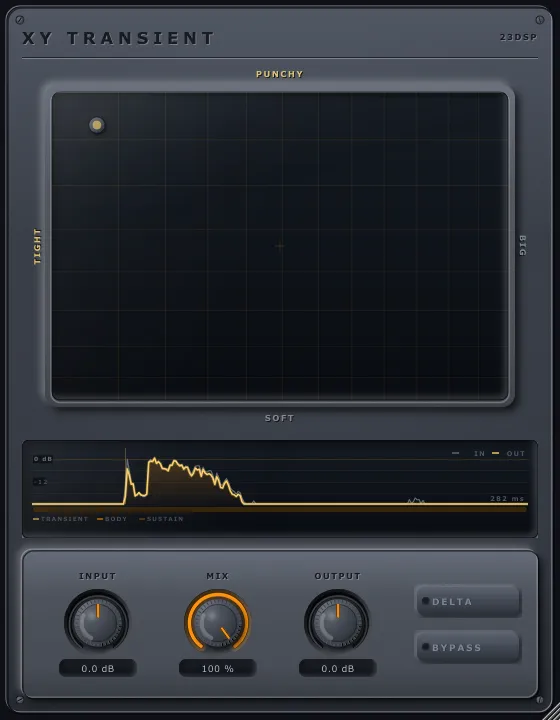
XY Transient asks two questions about a hit: how much room it takes up in time, and how hard its front edge lands. Those are the axes.
X — Size, TIGHT to BIG
How long the hit is allowed to last. Left shortens it; right lets it ring on.
This is the axis that replaces a sustain control, and the difference matters. A sustain knob scales what comes after the attack by a fixed amount. Size changes when the hit is considered over, which the detector works out from the material, so a 60 ms snare and a 400 ms tom are both “tightened” by the same pad position without you setting two different release times.
Far left — Room Killer territory — is where a recorded room disappears. That is the setting for percussion that was tracked in a live space and needs to not be.
Y — Impact, SOFT to PUNCHY
How hard the front edge lands. Down rounds it off; up sharpens it. Above about 0.75 the punchier settings bring in oversampled saturation, which is where the extra bite at the top of the axis comes from. Below that it stays out of the signal path entirely rather than sitting there at zero.
Soft is more useful than it sounds. Taking the click off a kick that is fighting a bass is often a better fix than EQ, and Soft Kick does it by about 5.7 dB over the first five milliseconds while leaving the body exactly where it was.
Why five bands
The usual failure of a transient shaper on a drum bus: you tighten the kick, and the detector — which is listening to the whole signal — pulls the cymbals down every time the kick lands. The bus starts breathing in a way nothing in it is doing.
XY Transient splits into five bands with linear phase and runs the detector per band. A source profiler decides what each hit is — kick, snare, cymbal wash — and weights the bands accordingly. With a steady 9 kHz tone under a kick every 500 ms, the tone moves by at most 1.1 dB at the TIGHT setting.
Linear phase also means the bands sum back to the input rather than to a phase-rotated copy of it. Two consequences you can hear: Mix at 0 % is the input bit for bit, so a parallel blend is a real blend, and switching bypass does not change the attack of a kick.
It costs 599 samples at 48 kHz — 12.5 ms — reported to the host and compensated for. This is a mixing plug-in, not one to track through.
Loudness compensation, and what it means for judging
A change in shape is compensated so it is not heard as a change in level. That is the whole reason the plug-in is usable by ear: without it, PUNCHY sounds better because it is louder, and you would pick it every time.
It also means you cannot judge this plug-in by watching a meter. Use Delta instead — it plays only what XY Transient is adding or taking away — and use the envelope display, which draws the transient, body and sustain of what is going through.
Where to start
| Material | Start at | Then |
|---|---|---|
| Kick with too much room | Room Killer | move right until the body comes back |
| Kick fighting the bass | Soft Kick | this is usually better than an EQ cut |
| Snare that needs to cut | Snare Snap | drop Mix to 70 % if it gets brittle |
| Drum bus, too loose | Drum Bus Tight | check the hats with Delta |
| Drum bus, too polite | Drum Bus Punch at 80 % Mix | the Mix is part of the preset |
| Bass that needs attack | Bass Pluck | or Bass Bigger to lengthen instead |
Sixteen presets ship plus Custom: Gentle Shape, Tight Kick, Bigger Kick, Soft Kick, Techno Punch, Snare Snap, Big Snare, Controlled Hats, Big Toms, Dry Percussion, Room Killer, Drum Bus Punch, Drum Bus Tight, Bass Pluck, Bass Bigger and Soft Guitar.
Expect a small number
At matched loudness a transient shaper changes an envelope by a few dB, not by twenty. On the demos on the product page, the biggest move on a kick is Soft Kick taking 5.7 dB out of the first five milliseconds; Room Killer takes 2.9 dB out of the 5–20 ms window. Those are the right sizes. Anything claiming to do more than that at the same loudness is moving the level and calling it punch.
Hearing it
There is a sound demo on YouTube: four bars dry, then eight bars wet, with the interface as it plays. The four bus presets on a kit. Small numbers, as the section above says — the thing to listen for is the hats staying put while the low end shortens. The product page has the same comparisons as an A/B player, plus a few the video leaves out.