How to Use XY Space: Distance Is Not a Wet/Dry Knob
What CLOSE to FAR and SMALL to HUGE actually move in XY Space, why distance is not a wet/dry knob, and how to use it as a send, as an insert and on a drum bus.
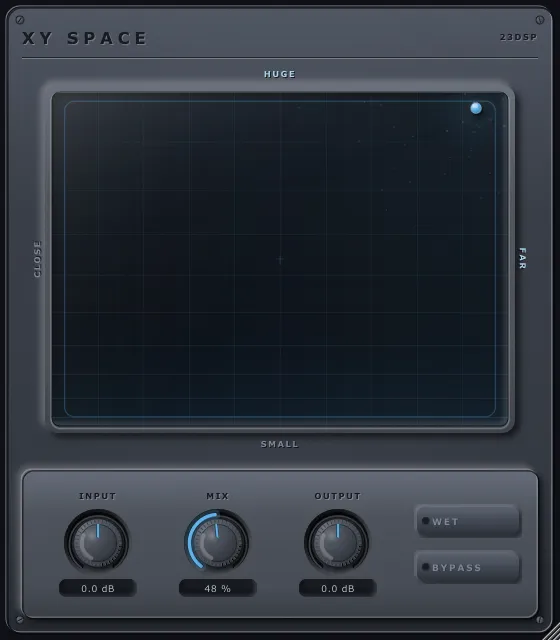
XY Space has two axes, a Mix, input and output trims and a Wet button. Everything a reverb normally asks for — decay, size, damping, diffusion, pre-delay — is derived from where the dot sits.
The horizontal axis: CLOSE to FAR
This is the one that is easy to get wrong, because most plug-ins do not have it.
Moving right does what physical distance does to a sound. Three things happen at once:
- The direct sound loses its top. Air absorbs high frequencies over distance, so something far away is darker — not quieter in a flat way, darker.
- The reflected sound gains ground on the direct sound. The ratio between them is most of what your ear uses to judge distance.
- The early reflections arrive later and closer together. Further from the source means further from the walls that are bouncing it back.
A wet/dry knob gives you the second of those and nothing else, which is why turning a reverb up makes a part louder-and-wetter rather than further away.
Mix is still a dry to wet balance. The darkening and the narrowing are part of what the plug-in does, so they fade out with the reverb: at Mix 0 % you get the input back, at any pad position, and the colouring is at full depth by the time Mix reaches 15 %. Every factory preset sits above that, so they model their distance in full.
The vertical axis: SMALL to HUGE
Scale. Moving up lengthens the delays in the network, lengthens the decay, and pushes the early field later and sparser. A big place is not just a long reverb — it is one where the first reflections take a while to come back and there are fewer of them close together.
The two axes are independent on purpose. Close and huge is a cathedral with the microphone at the front — a real place, and one most reverbs cannot make. Far and small is a booth heard from outside it.
What is behind the pad
A 32-line feedback delay network with an orthogonal feedback matrix, so the tail stays dense without ringing on a note. An early reflection field injected into every line of that network rather than summed on top of it, which is what makes the early sound and the tail feel like one place. Input diffusers that stay allpass at every setting, so they do not comb as they fade in. Frequency-dependent decay, so the low end outlasts the top.
There is also an input analyser that holds back the diffusion on transient-heavy material, which is why a drum bus does not smear the way it does in a reverb with a fixed diffuser.
Moving the pad while it plays
You can. It crossfades between read positions in the delay lines rather than sliding them, so sweeping across the pad over a decaying tail does not bend pitch the way a sliding delay would — a click anywhere on the pad shifts the reverb by at most a few cents. Gains and filters are ramped and the delay-length fades are staggered, so there is no zipper and no flutter.
That makes the pad automatable in a way most reverbs are not. A part that walks from CLOSE to FAR across eight bars is one automation lane.
Three ways to use it
As a send, Mix at 100 %. The usual way. Put the pad where the room should be and let the channel faders decide how much of it you hear. The Wet button drops the direct sound, which is what you want on a send so the dry signal is not arriving twice.
As an insert, Mix 20–40 %. When a part needs to sit behind something rather than be surrounded by a room. This is where the distance axis earns its place: a vocal at CLOSE with Mix at 25 % is a vocal in a room, and the same vocal at 0.5 on the distance axis is a vocal two metres further back.
On a drum bus, SMALL and CLOSE. The job there is glue, not space. Tight Booth and Drum Room are the two to try, with Mix low enough that you notice it when you bypass it and not before.
Where to start
Sixteen presets ship, and they are only places on the pad, so dragging away from one is expected. Tight Booth and Drum Room for small and close. Vocal Close Hall for a part that needs size without distance. Huge But Clear when you want a big place that does not swallow the words. Cathedral Back Wall and Deep Cavern when something should disappear.
Two practical notes
Mono in, stereo out works, which is what you want on a mono vocal or synth — the plug-in builds the width rather than widening something that was never wide.
The reported tail is 15.4 seconds, derived from the longest decay the pad can reach. Hosts that trim renders on tail length will not cut a long setting short, but they will also wait 15 seconds at the end of a bounce. That is the price of not having the tail clipped.
Hearing it
There is a sound demo on YouTube: four bars dry, then eight bars wet, with the interface as it plays. Three places on the pad, from a booth to the back wall of a cathedral. The product page has the same comparisons as an A/B player, plus a few the video leaves out.