XY Space
How far away it is, and how big the place is.
- Formats
- VST3 · AU
- Platforms
- Windows · macOS · Linux
- Requirements
- 64-bit host; stereo in and out, or mono in and stereo out · 44.1 to 192 kHz · macOS 11 or newer, Windows 10 or newer, Linux x64 · No latency
Most reverbs ask for decay time, size, damping, diffusion, pre-delay and a row of filters, then leave you to work out which combination means further back and which means bigger room.
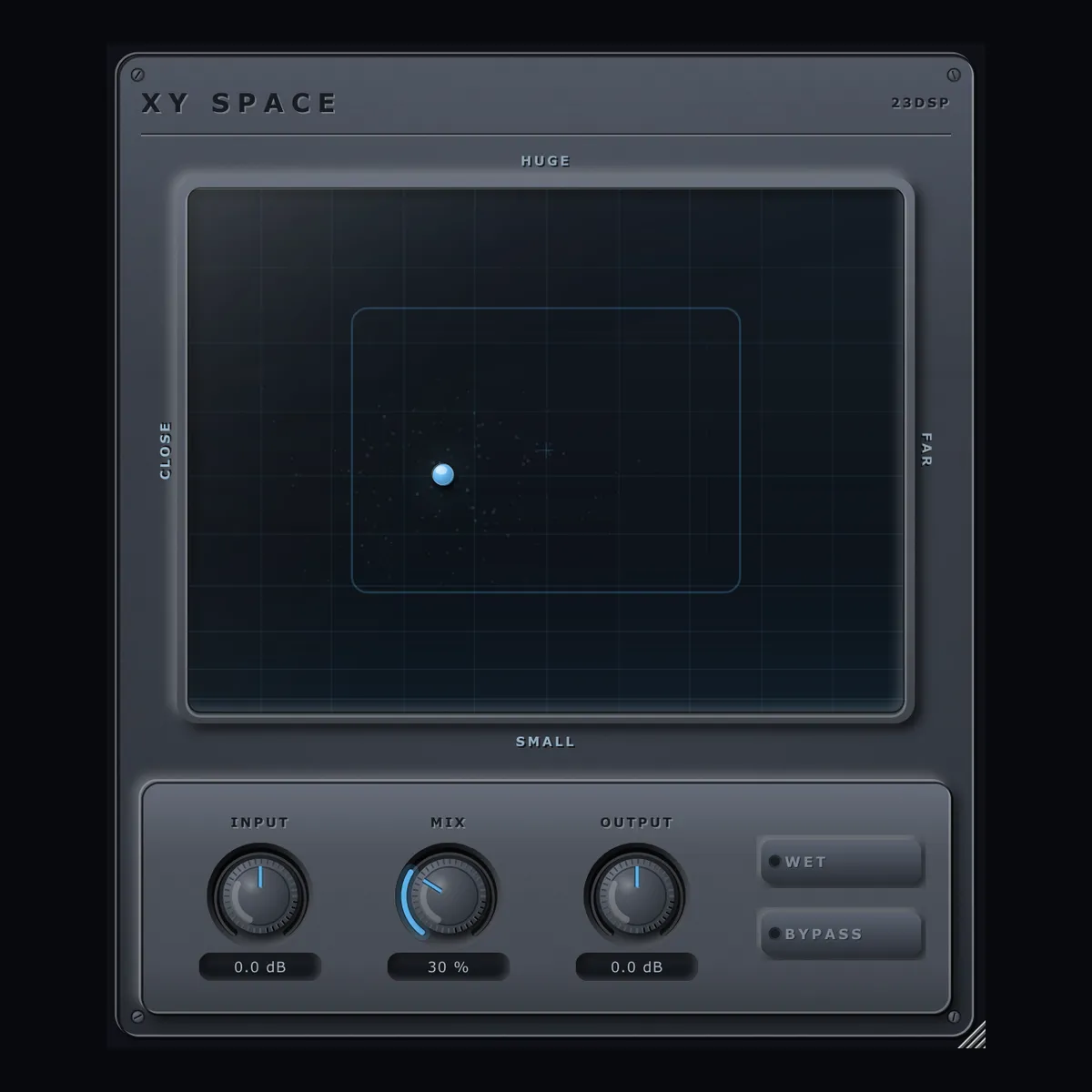
XY Space asks the two questions you already have in mind. Across the pad is distance, CLOSE to FAR. Up the pad is scale, SMALL to HUGE. That is the whole interface.
What distance actually changes
Moving right does what distance does. The direct sound loses its top and gives ground to the reflected sound, and the early reflections arrive later and closer together — three things at once. A wet/dry knob gives you the second of those alone, which is why turning a reverb up makes a part wetter rather than further away.
All three are the effect, so they fade out with it: Mix at 0 % is the input, at any pad position, and the colouring reaches full depth by Mix 15 %. Every factory preset sits above that.
Moving up makes the place bigger: longer delays, a longer decay, a later and sparser early field.
What is behind the pad
- A 32-line feedback delay network with an orthogonal feedback matrix, so the tail stays dense without ringing on a note.
- An early reflection field injected into every line of the network, which is what ties the early sound to the tail instead of stacking one on the other.
- Input diffusers that stay allpass at every setting, rather than combing as they fade in.
- Frequency-dependent decay, so the low end outlasts the top the way a real room does.
- An input analyser that keeps a transient-heavy source from smearing.
Presets
16 plus Custom: Balanced Space, Tight Booth, Drum Room, Short And Wide, Vocal Close Hall, Dark Chamber, Small And Far, Distant Percussion, Close Cinematic, Huge Foreground, Huge But Clear, Techno Atmosphere, Giant Warehouse, Endless Pad, Cathedral Back Wall and Deep Cavern. They are places on the pad, so you can always drag away from one.
Where it fits
As a send with Mix at 100 %, which is the usual way. As an insert between 20 and 40 %, when a part needs to sit back rather than be surrounded by a room. On a drum bus at SMALL and CLOSE, where the job is glue. At HUGE and FAR on anything that should disappear into the distance.
Tested before it ships
pluginval at strictness 10 passes on Windows, macOS and Linux, and auval passes for the
Audio Unit. Mix 0 % nulls within 0.05 dB across the audible band, at any pad position. Output is
bit-identical from 1 to 8192 samples per block, and a repeated render matches the first. The
reported tail is 15.4 s, derived from the longest decay the pad can reach, so hosts that trim on
tail length do not cut it short. NaN or infinity is contained and the network recovers; silence
in is exact silence out.
Watch it
Screenshots
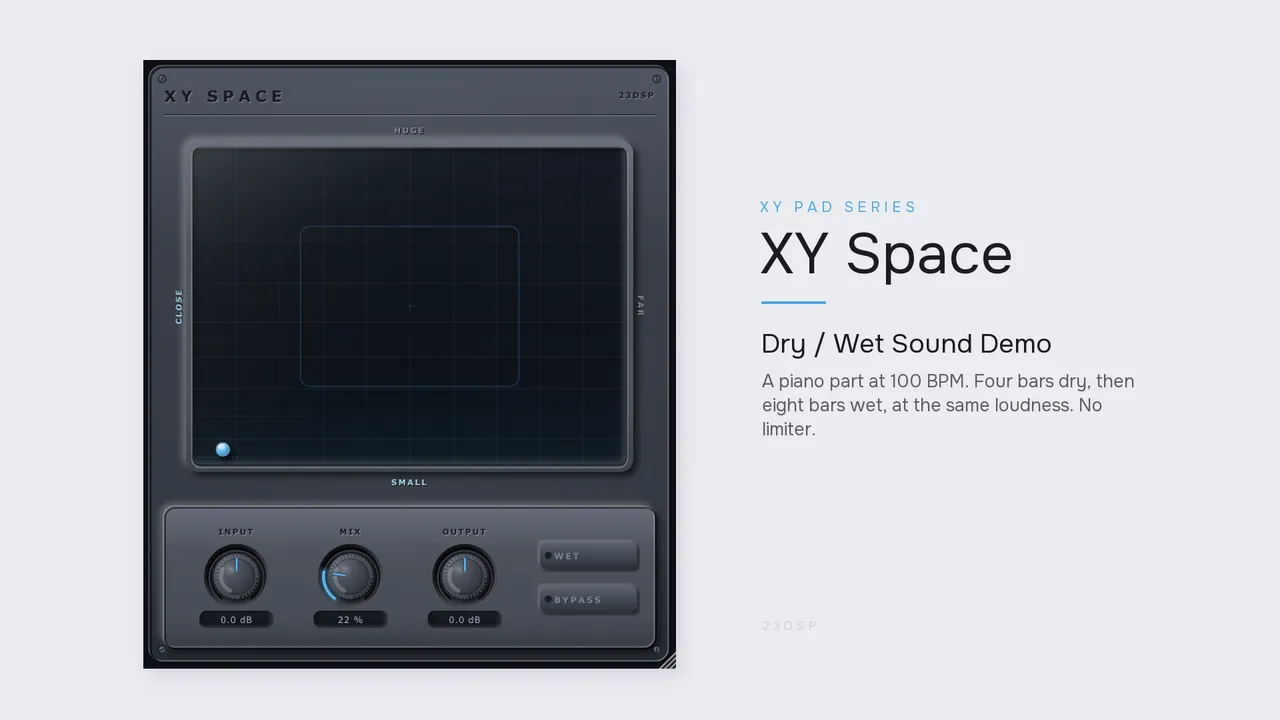
Tight Booth. Bottom left is small and close — the early field arrives fast and the tail barely exists. Cathedral Back Wall. Top right is huge and far, where most of the energy has moved into the tail. Wet-only, for a send. The direct sound is dropped and only the space is left. Set by hand rather than recalled. The pad is the interface; the presets are just places on it.
Hear it
- KeysA 100 BPM piano part from a Future Pop Music construction kit. Dry is the untouched source file and every other file is the plug-in brought to the same loudness. The source goes in at −10 dBFS and there is no limiter.0:00–:––Level100%
- DrumsThe drum bed from the same kit, where the early field does most of the work and the tail is there to glue rather than to be heard.0:00–:––Level100%
- ArpAn arpeggio, where a long tail has the most to smear and the clearest chance to go wrong.0:00–:––Level100%
Release notes
1.0.1
- First stable release. Signed and notarised on macOS, with a Developer ID installer and no Gatekeeper detour.
- Two controls instead of ten. Across the pad is distance: moving right takes the top off the direct sound, gives ground to the reflected sound and lets the early reflections arrive later and closer together. Up the pad is scale: longer delays, a longer decay, a later and sparser early field.
- Mix is a dry to wet balance throughout: the distance colouring of the direct sound is part of the effect and fades out with it, so Mix at 0 % hands back the input at any pad position. It is at full depth by Mix 15 %, which every factory preset sits above.
- A 32-line feedback delay network with an orthogonal feedback matrix, so the tail stays dense without ringing on a note.
- An early reflection field injected into every line of the network, which ties the early sound to the tail rather than layering one on the other.
- Frequency-dependent decay, so the low end outlasts the top the way a real room does, and input diffusers that stay allpass at every setting.
- Moving the pad crossfades between read positions rather than sliding them, so sweeping over a decaying tail does not bend pitch, step or flutter.
- The safety guard watches the network for divergence rather than the output level, so input and output gain can be pushed without the plug-in clipping the dry signal.
- 16 presets plus Custom, from Tight Booth to Deep Cavern. Mono in and stereo out is supported, which is what a mono vocal or synth needs.
- Validated with pluginval at strictness 10 on Windows, macOS and Linux and with Apple's auval. Mix 0 % nulls within 0.05 dB from 20 Hz to 20 kHz, output is bit-identical from 1 to 8192 samples per block, and the reported tail of 15.4 s covers the longest decay the pad can reach.
From the journal
Related
More Reverb & Space
All reverb & space plugins
XY Space is sold through Gumroad, which handles checkout, licences, downloads and updates.
Buy on Gumroad