The XY Series: Four Plug-ins, Two Decisions Each
XY Bass, XY Space, XY Reverse Slicer and XY Transient are out at 1.0.0. Four plug-ins that put a whole processing chain behind two named axes on a pad. €10 each, €23 together.
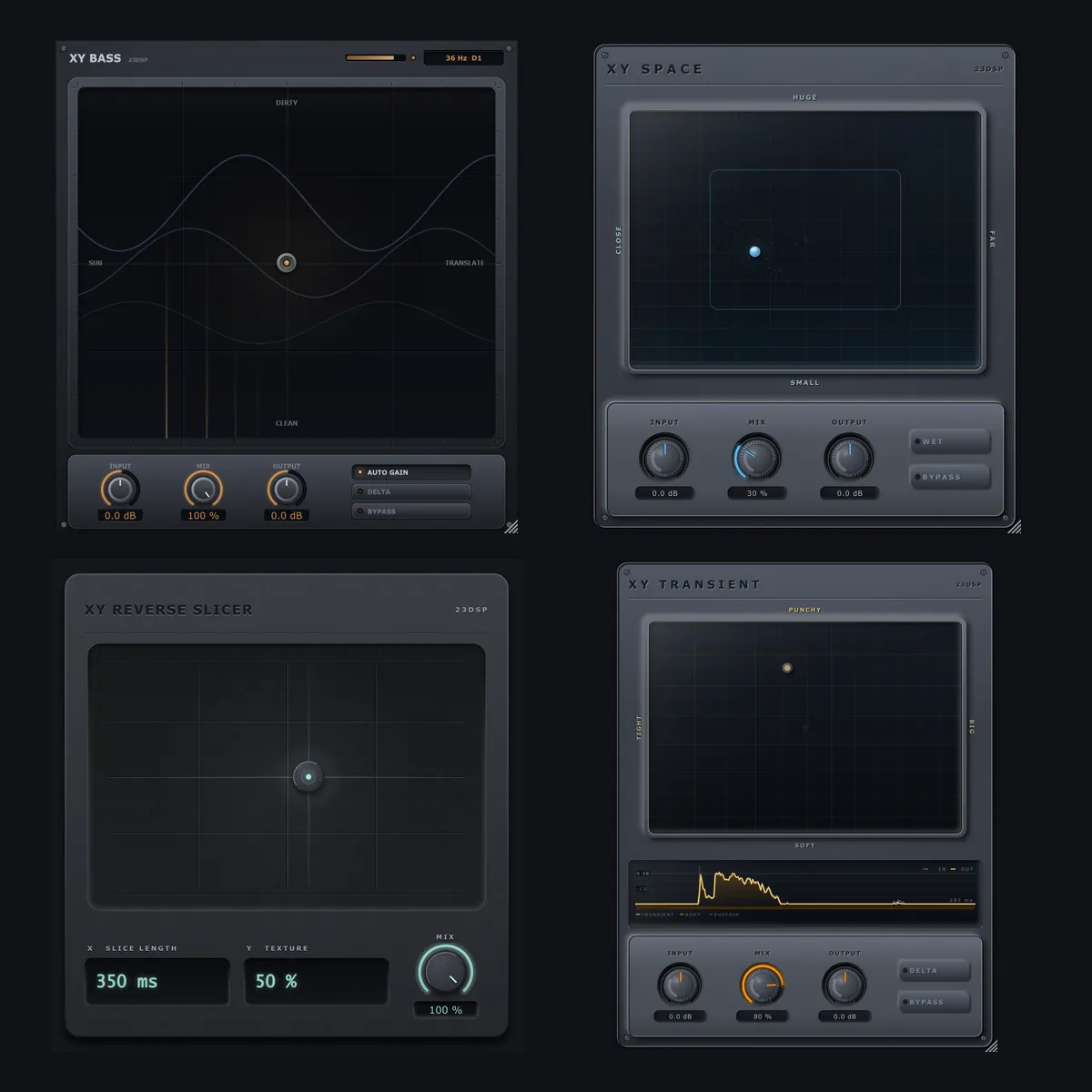
Four plug-ins are out today, all at 1.0.0: XY Bass, XY Space, XY Reverse Slicer and XY Transient. They are €10 each, or €23 for the XY Series, which is all four.
They were built as one idea rather than four, so they are easier to explain together.
The idea
Most mixing tools hand you the mechanism. A transient shaper gives you attack and sustain and leaves you to work out which band, how fast and how much. A reverb gives you decay time, size, damping, diffusion and pre-delay, and leaves you to work out which combination means further back and which means bigger room.
That is the right design when you know exactly what you want to change. It is the wrong one when you know what you want to hear — a bass that still reads on a phone, a snare that stops ringing, a part that sits behind the vocal — and the mechanism is in the way.
The XY plug-ins put the outcome on the axes and the mechanism underneath.
- XY Bass — SUB to TRANSLATE across, CLEAN to DIRTY up.
- XY Space — CLOSE to FAR across, SMALL to HUGE up.
- XY Reverse Slicer — slice length across, crossfade texture up.
- XY Transient — TIGHT to BIG across, SOFT to PUNCHY up.
Behind each of those pads is a chain that would otherwise be a panel of controls: crossovers, detectors, generators, decay times, drive, lookahead. The plug-in reads what you gave it and sets them from where you put the dot. An 808 and a kick drum do not get the same treatment from the same position on XY Bass’s pad, because they are not the same problem.
That is the trade, and it is worth saying plainly: you give up individual control of a dozen parameters, and you get a decision you can make by ear in two seconds. If you want the dozen parameters, these are not the plug-ins for that.
What each one is for
XY Bass is a sub synthesiser and a translator in one. Where the fundamental of a bass note is there, it reinforces it; where it is missing, an oscillator locked to the tracked pitch puts it back, rather than following whichever harmonic happens to be loudest. Move right and it trades that depth for harmonics — the ones that let a 40 Hz note read as bass on a laptop speaker that cannot reproduce 40 Hz. It is at its most precise on one low source, where it can track the note, but it earns its place on a mix bus too: Club Sub there adds about 15 dB in the 40 to 60 Hz band and leaves everything above 90 Hz alone.
XY Space is a reverb built on a 32-line feedback delay network with an orthogonal feedback matrix, an early reflection field injected into every line of that network, and decay that is frequency-dependent so the low end outlasts the top. Distance is modelled rather than faked: moving right takes the top off the direct sound, hands ground to the reflected sound and spaces the early reflections differently, which is what actually makes something sound further away rather than merely wetter.
XY Reverse Slicer records what goes into it and plays each completed slice backwards, crossfading one into the next. At 20 ms it is a stutter; at two seconds a chord arrives instead of decaying. The slice boundaries follow the song timeline while the transport runs, so a bounce matches what you heard and locating around the arrangement does not restart the pattern wherever the playhead landed.
XY Transient shapes how a hit lands and how long it stays, over a five-band linear-phase split with a source profiler and lookahead detection. The usual failure of a transient shaper on a drum bus is that tightening the kick pulls the whole top end down with it. Here, with a steady 9 kHz tone under a kick every 500 ms, the tone moves by at most 1.1 dB at the TIGHT setting.
One rule they all keep
Mix at 0 % hands back the input. In XY Bass, XY Reverse Slicer and XY Transient it is bit for bit — not nearly, identical. XY Space’s dry path goes through a mid/side matrix, so there it is a rounding residual at −144 dBFS instead, which is under the noise floor of a 24-bit file.
That sounds like a small thing until you have spent an afternoon A/B-ing a parallel blend against a plug-in whose dry path is not actually dry.
The rest of what they share:
- Signed and notarised on macOS, universal, with an installer that opens without a trip through System Settings.
- VST3 and AU on macOS; VST3 on Windows and Linux, with LV2 alongside it for XY Reverse Slicer and XY Transient on both, and for XY Space on Linux.
pluginvalat strictness 10 on Windows, macOS and Linux, andauvalfor the Audio Unit, on every build.- Output that is bit-identical whatever block size the host uses, and a NaN from a plug-in upstream contained rather than passed on.
Hearing them
Each one has a sound demo: XY Bass, XY Space, XY Reverse Slicer and XY Transient. Four bars dry, then eight bars wet, with the interface as it plays.
Every product page has an A/B player. The rule for all of it is the same: dry is the untouched source file, and every wet file is the plug-in brought to the same loudness. The sources are 100 BPM loops from a Future Pop Music construction kit, in at −10 dBFS, with no limiter anywhere. Nothing on those pages is louder than the dry, so what you hear is the plug-in and not the level.
A couple of things that measurement turned up, and that the pages say out loud:
- XY Space’s dry files are the source file itself, which is also what its Mix 0 % now returns at any pad position.
- XY Transient compensates loudness internally, so its wet renders needed no matching at all. What changes is the shape of the hit: Soft Kick takes 5.7 dB out of the first five milliseconds of a kick and leaves the body where it was.
Prices
€10 each. €23 for all four. Buy one now and the rest later and you pay the single prices, so the bundle is only worth it if you want more than two.