XY Reverse Slicer
Everything you play, handed back backwards.
- Formats
- VST3 · AU · LV2
- Platforms
- Windows · macOS · Linux
- Requirements
- 64-bit host, stereo in and out · 44.1 to 192 kHz · macOS 11 or newer, Windows 10 or newer, Linux x64 · No latency
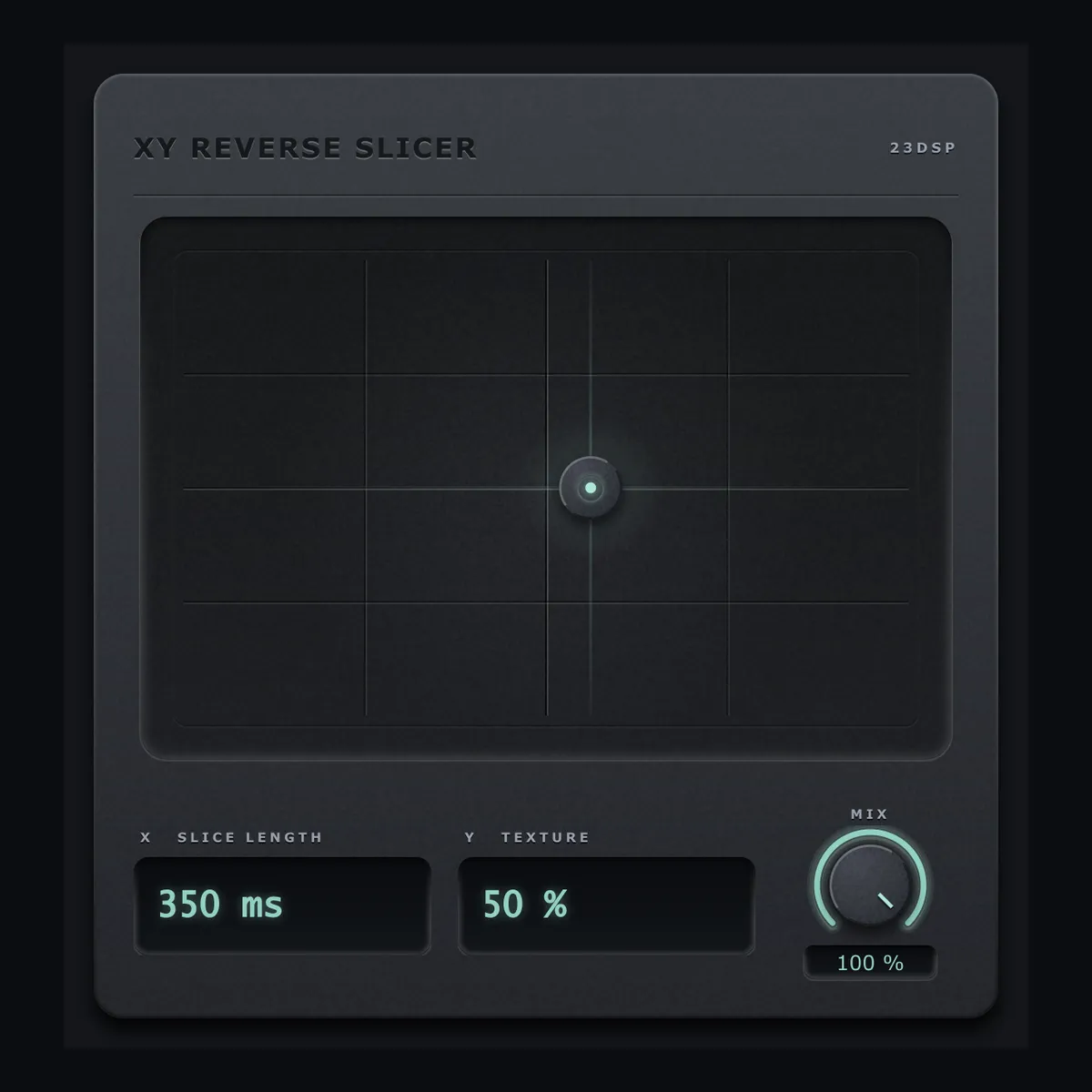
XY Reverse Slicer records what goes into it and plays each completed slice in reverse, crossfading one slice into the next. Short slices turn a vocal into a stutter. Long ones turn a chord into a swell that arrives instead of decaying. Between the two is a wide range of rhythmic chopping that follows whatever you feed it, because the slices come from the material rather than from a sequencer.
Two axes and a mix:
- X — slice length, 20 ms to 2 seconds, skewed so the middle of the pad is 250 ms.
- Y — texture, the crossfade between consecutive slices: from 1.5 ms, a hard cut, up to half the slice, which laps every slice over the next.
- Mix, equal power, so dry and wet sum to the same loudness as either alone.
Slices land on the grid
While the transport is playing, slice boundaries follow the song timeline rather than the moment you pressed play. Two things follow from that:
- A bounce matches what you heard. Rendering a section gives the same slicing as playing it, in any host.
- Looping and locating keep their place. Jumping around the arrangement re-anchors to the timeline instead of restarting the pattern wherever the playhead landed.
With the transport stopped it free-runs, so live input still slices.
Where it fits
On a vocal, for the stutter that turns a line into a hook. On a melody or chord loop, long, for reverse swells that lead into the next bar. On drums, short, for a scramble that still follows the groove. On a send with Mix low, as an effect that comments on the part rather than replacing it.
Tested before it ships
pluginval at strictness 10 passes on Windows, macOS and Linux, and auval passes for the
Audio Unit. Mix at 0 % is the input bit for bit, and so is bypass. The crossfade holds level: the
slice windows sum to unit power within 0.0000002, so where consecutive slices are unrelated the
fully wet level holds within about 0.01 dB, at every sample rate tested from 22.05 kHz to
384 kHz. Where they are correlated the two windows do not sum to unity — that is the arithmetic
of a cos/sin crossfade, not a fault — and at the extreme, with every sample inside a crossfade,
the level can move by up to +2.1 or −4.4 dB. On a musical part at the shortest slices with the
texture at maximum, the most measured is about half a decibel. Sweeping
slice length and texture while it plays produces no step larger than the ordinary crossfade.
Output is bit-identical from 1 to 5000 samples per block, including irregular block sizes. The
reported tail is 4 s, the longest the effect can produce, so hosts stop trimming the reversed
tail when the slice is long. There is no latency and no allocation on the audio thread.
Watch it
Screenshots
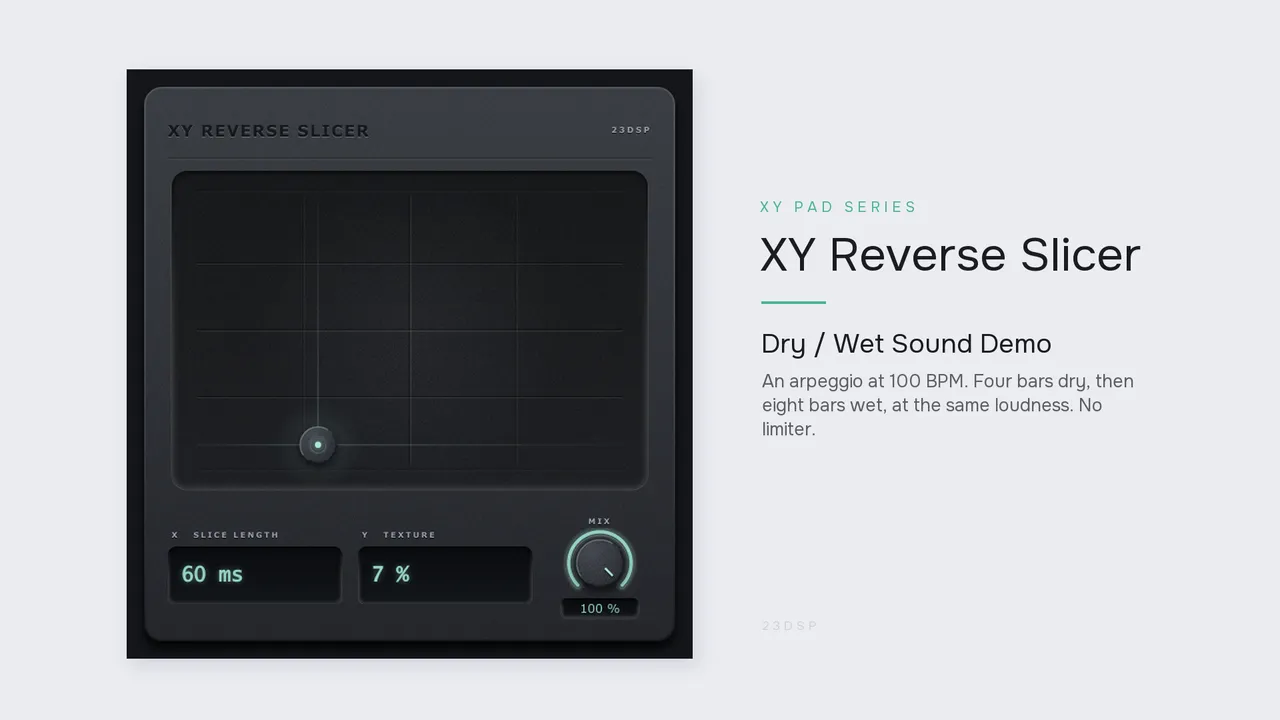
Short slices, hard cuts. 60 ms with almost no crossfade is where a line turns into a stutter. Long slices, full lap. At 1.6 s with the crossfade at 90 % each slice runs over the next one and a chord arrives instead of decaying. Mix is equal power, so a parallel blend sits at the same loudness as either side on its own.
Hear it
- ArpA 100 BPM arpeggio from a Future Pop Music construction kit. Dry is the untouched source file and every other file is the plug-in brought to the same loudness. The source goes in at −10 dBFS and there is no limiter. Reversing a slice keeps its samples, so these files measure almost identically to the dry — everything you hear is rearrangement, not level.0:00–:––Level100%
- KeysA piano part from the same kit. The blend is 305 ms slices at Mix 42 %, which comments on the part rather than replacing it.0:00–:––Level100%
- DrumsThe drum bed, where short slices scramble the groove without losing the grid, because the slice boundaries follow the song timeline.0:00–:––Level100%
Release notes
1.0.0
- First stable release. Signed and notarised on macOS, with a Developer ID installer and no Gatekeeper detour.
- X is slice length, 20 ms to 2 seconds, skewed so the middle of the pad is 250 ms and the musically useful range is where your hand already is.
- Y is texture: the crossfade between consecutive slices, from 1.5 ms — a hard cut — up to half the slice, which laps every slice over the next one.
- Slice boundaries follow the song timeline while the transport is playing, so a bounce matches what you heard and jumping around the arrangement re-anchors instead of restarting the pattern. With the transport stopped it free-runs, so live input still slices.
- Mix is equal power, so dry and wet sum to the same loudness as either one alone.
- Validated with pluginval at strictness 10 on Windows, macOS and Linux and with Apple's auval. Mix 0 % is the input bit for bit, the slice windows sum to unit power within 0.0000002, and output is bit-identical from 1 to 5000 samples per block including irregular sizes.
From the journal
Related
XY Reverse Slicer is sold through Gumroad, which handles checkout, licences, downloads and updates.
Buy on Gumroad