Time Terrarium 0.10: Three Habitats That Leave Pitch Alone
Time Terrarium 0.10.0-rc1 adds Slate, Quartz and Loam — three species of echo that hold pitch exactly — a Clean preset group of eight, and a fix for the reversed habitat, whose two channels were detuned against each other.
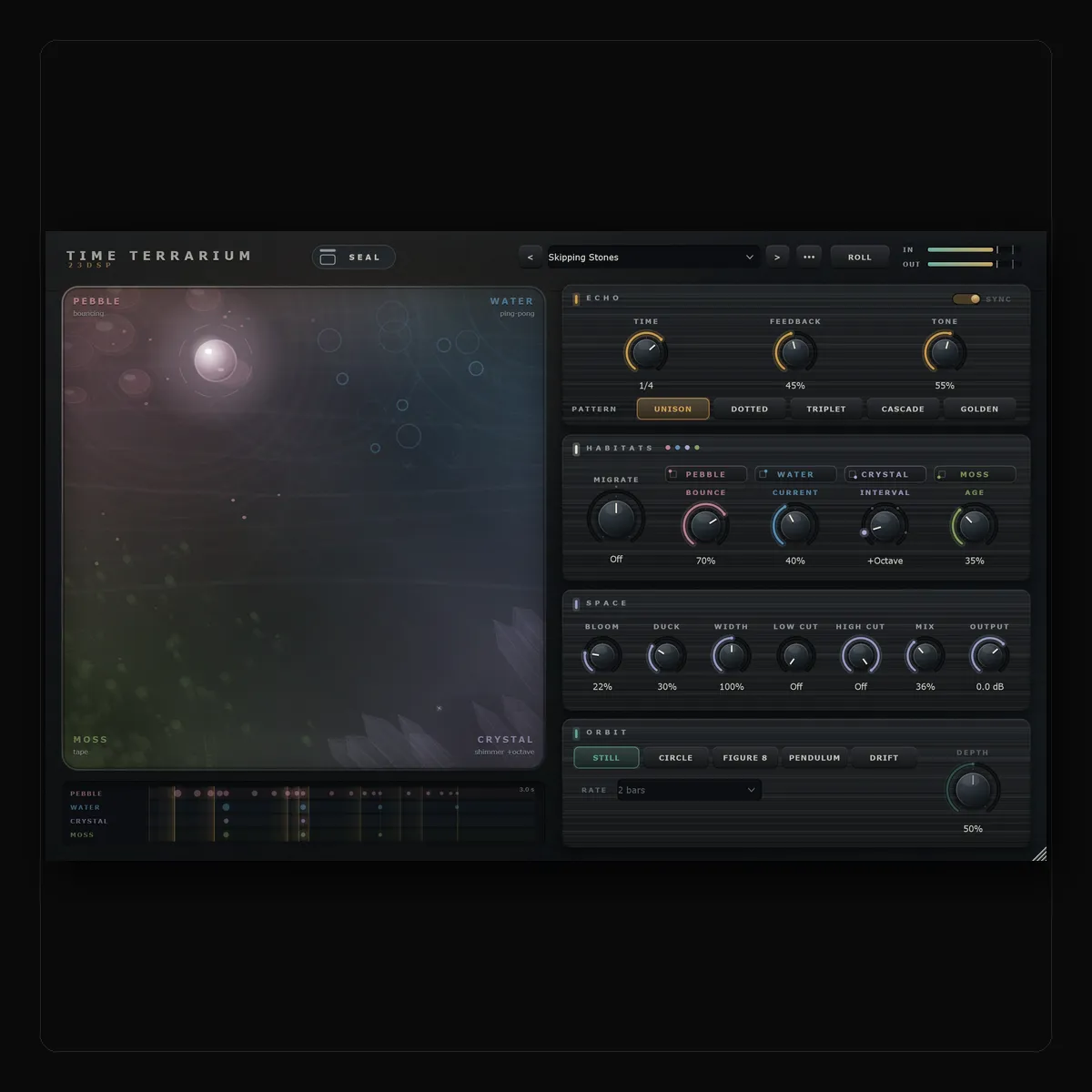
A customer wrote in last week after watching the demo video: the delays sounded like they were changing the pitch, was that on purpose, and could it be turned off?
The honest answer was yes, mostly on purpose. Crystal is a shimmer delay and transposing the repeats is its entire job, and it is planted in one of the four corners by default, so it turns up in most of the factory presets. Moss wows like the tape it is imitating. Water sweeps its read position, which is where its swirl comes from. All three of those are the point of those species.
But the question was a fair one, and working through the answer turned up two things worth fixing. Time Terrarium 0.10.0-rc1 is the result.
Key takeaways
- Three new species — Slate, Quartz and Loam — that change the character of a repeat without moving it in pitch. That takes the plug-in from eight species to eleven.
- A new Clean preset group: eight presets built only from species that hold pitch.
- A real bug fixed. The reversed habitat read its right channel at a slightly different rate from its left, so the two sides were detuned against each other by roughly a quarter of a semitone.
- Presets and sessions carry over. The new species were appended to the list rather than inserted, so a 0.9 session opens with the habitats it was saved with.
The bug in the reversed habitat
This one I am glad to have found. Ash plays the buffer backwards, and it widened its stereo image by reading the right channel at 0.985 times the position of the left. That sounds harmless written down. It is not: scaling a read position scales the playback rate, so the right channel was running 1.5% slow against the left — about 26 cents flat, a quarter of a semitone — and the gap grew as the reversed head travelled.
On a drum loop you would probably hear that as width, which is why it survived a release. On anything with a held note in it, you hear two voices pulling apart.
The fix is small: the width now comes from a constant offset, capped at 6.5 ms or 5% of the fragment length, whichever is smaller. An offset is a delay. A scale factor is a pitch change. Ash still spreads across the stereo field, and both channels now play at the same speed.
Three species that hold pitch
The other half of the answer was that if you wanted character from a delay without any pitch movement at all, the old roster did not really give it to you. Frost and Pebble qualified, but one is a diffuser and the other is a bouncing tap, so “clean but interesting” was not on the menu.
- Slate is a plain delay with a Drive control. At zero it is transparent; at the top the repeats saturate and thicken as they decay. Nothing modulates.
- Quartz re-triggers a slice of the echo. Slice sets how short the fragment is and how many times it repeats, from one long pass to six quick ones. The slice edge is a short amplitude gate rather than a crossfade — blending two taps at different phases is exactly the thing that would bend the pitch, so it does not do that.
- Loam grinds. Degrade runs a sample-and-hold and a bit-depth reduction together, from 15-bit down to 4-bit, while the read pointer keeps moving at one speed. Lo-fi, in tune.
Each one gets its own artwork in the glass, the same as the other eight.
Eight Clean presets
The new Clean group is built only from species that leave pitch alone:
- Straight Line — a plain digital echo. Nothing modulates and nothing moves.
- Warm Plate — driven repeats that thicken as they decay.
- Dry Stone — a tight sixteenth slap with bouncing taps behind it.
- Stone Steps — clean repeats stepping between taps in a dotted pattern.
- Stutter Grid — re-triggered slices locked to the beat.
- Broken Tape — bit-crushed dub repeats that grind without drifting.
- Gravel Path — grit and stutter slices trading places in triplets.
- Cold Storage — a wide still room, frost diffusion over clean repeats.
That takes the bank from 30 presets in six groups to 38 in seven.
Checked by the build
Claims like “this one holds pitch” are easy to make and easy to get wrong, so the test suite now measures it. A 330 Hz tone goes through a terrarium planted with four copies of the same species, at the bottom, middle and top of its Character control, and the build tracks the phase of that tone to work out how far it drifts. Frost, Pebble, Slate and Loam have to stay inside 2 cents. For Ash, the two channels have to agree with each other inside 3 cents — which is the test that would have caught the bug above.
Quartz is not in that set, because its slice edges are deliberate transients and the measurement reads them as movement. Its read pointer never changes rate, which is the part that matters.
Getting it
The update is free if you already own it: the download link on your Gumroad receipt now serves 0.10.0-rc1. Your presets and sessions carry over — the three new species were appended to the species list rather than inserted into it, so a session saved in 0.9 opens with the habitats you saved.
Still a release candidate, so if something misbehaves in your DAW, mail hi.23dsp@gmail.com with your OS and host and it goes to the top of the list.
What the plug-in does in the first place is covered in the launch post.