Dualite
Two chains, not one. Left and right, or mid and side.
- Formats
- VST3 · AU · LV2
- Platforms
- Windows · macOS · Linux
- Requirements
- 64-bit host, mono or stereo · macOS 11 or newer, Windows 10 or newer, Linux x64 · Latency reported to the host, and only when an effect needs it
Most multi-effects give you one rack and run your whole signal through it. Dualite gives you two independent racks, and lets you decide what the two halves of your signal are: left and right, or mid and side. That one decision is the plugin.
A high pass on the side channel only, so the low end collapses to the centre while the top stays wide. Reverb on the side and nothing on the mid, so a lead opens up without moving backwards. A fast compressor holding the centre steady while a slow one lets the room breathe. A delay with two different times, so the repeats cross the image instead of sitting on top of it. None of that is a preset trick — it is what having two chains means.
Four lanes
Left and Right are the main pair; switch to M/S and they become Mid and Side. Everything else works the same — only what the two lanes carry changes. Behind each one sits a parallel lane with its own Send, Mix and Out, for New York compression, parallel saturation, or a reverb send that never touches the dry path. Parallel lanes stay collapsed to a narrow rail until you switch one on.
24 effects
Each can sit anywhere in either chain, up to eight deep, in any order.
Tone — EQ, Filter, Analyzer. Character — Saturation, Clipper, Bitcrusher, Phase Distortion, Noise. Dynamics — Compressor, Limiter, Gate, Transient Shaper, Gain. Space — Reverb, Convolution Reverb, Delay, Granulator, Tape Stop. Movement — Chorus, Flanger, Phaser, Tremolo, Ring Mod, Frequency Shifter.
The effects that can bite — saturator, clipper, phase distortion, ring mod, frequency shifter — each carry their own oversampling control, defaulting to what that effect actually needs.
Modulation and macros
Four modulation slots, each an LFO, an envelope follower or an ADSR. LFOs run sine, triangle, saw, square, random or a curve you draw by hand, free or synced. Followers and ADSRs listen at a tap point you choose — a lane’s input, or before or after any single effect in it. Right-click any control to assign one, with a depth and a polarity; because the chains are independent, one source can drive the two sides in opposite directions.
Then eight macros, each mapped to as many destinations as you like, automatable from your host under their own names.
90 presets
Ten categories — Tone Shaping, Character, Dynamics, Space, Movement, Stereo Field, Lo-Fi, Sound Design, Mix Bus, Utility — tagged by instrument and genre, so searching “snare”, “trap” or “width” finds something instead of making you scroll. Every one carries a description of what it does and when to reach for it. Stereo Field is where the plugin explains itself.
In your session
Every control in every slot is exposed to your host, named for whatever occupies the slot and renamed when you change it — and bound to the position, so reorder a chain and your automation follows the slot. Sixty-four steps of undo cover chains, preset loads and assignments. A/B snapshots hold two complete states. Host bypass is crossfaded and delay-compensated rather than a hard mute, and the window resizes to any size you drag it to, in either theme.
Screenshots
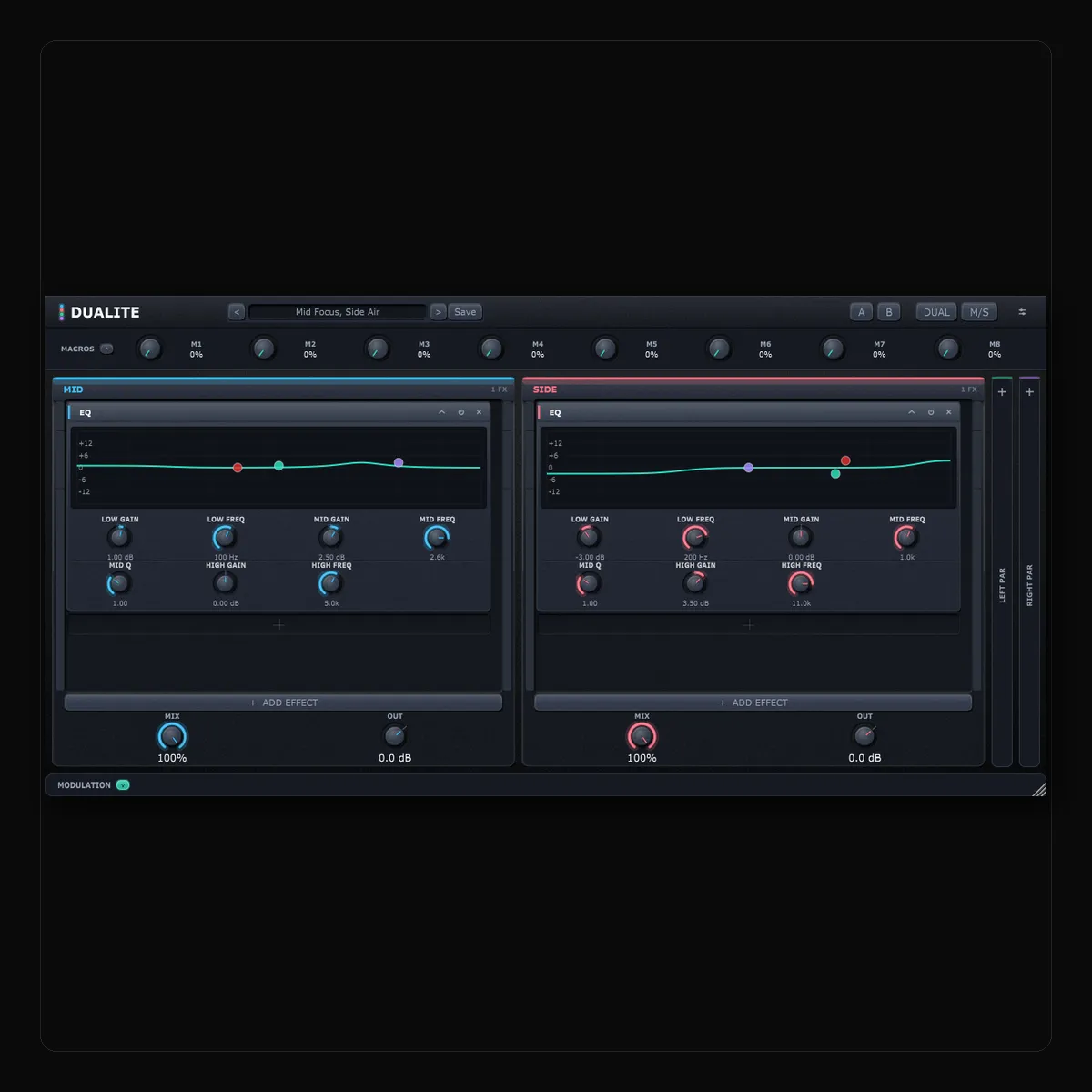
Mid and Side, each with its own EQ. Presence in the middle where the vocal and the snare are, air at the sides where the room is — one EQ across the pair cannot do both. All four lanes open. The main pair runs dry while the parallel pair carries the crush, blended back at 40%. Left and right on different delay times. The plainest demonstration that the two chains are independent rather than a linked pair. Four effects deep in both lanes. Chains go eight slots deep and stay readable when full. There is a light theme too.
Hear it
- Full mix — mid/side movesAn excerpt from one of my own tracks. Level-matched, so the only thing that changes is what the two chains are doing.0:00–:––Level100%
- Wide mix — working on the imageA wider excerpt, where the side channel has plenty to work with. Side Reverb and Haas both leave the centre exactly where it was.0:00–:––Level100%
- Club mix — two chains, not two settingsPing Pong runs different delay times per side and Opposing Sweeps drives the two chains in opposite directions from one modulator. Neither is possible with a single chain.0:00–:––Level100%
Release notes
1.0.0-rc4
- First public release, built on the Season 02 framework.
- Two independent chains, switchable between left/right and mid/side, each with its own parallel lane.
- 24 effects, eight slots per lane, reorderable by drag and drop.
- Four modulation slots — LFO, envelope follower or ADSR — plus eight host-automatable macros.
- 90 presets across ten categories, searchable by instrument and genre.
- Signed and notarised macOS installer; VST3, AU and LV2 on macOS, VST3 and LV2 on Windows and Linux.
From the journal
More Stereo
All stereo plugins
Dualite is sold through Gumroad, which handles checkout, licences, downloads and updates.
Buy on Gumroad